Microdosing Psilocybin Is More Common Than You Think: What a National Survey Shows
If you have microdosed psilocybin, or are thinking about it, you may assume it is a niche practice. A new national survey suggests otherwise.
In a probability-based survey of more than 10,000 U.S. adults, RAND researchers estimated that about 11 million adults used psilocybin in the past year. Most of them had microdosed: 69% of past-year psilocybin users microdosed at least once. That makes microdosing far from a fringe practice, and it raises practical questions about safety and support.
Below I walk through what the study found, what it can't tell us, and what I would want anyone who microdoses to consider.
What did the RAND psychedelics survey find?
Psilocybin is by far the most used psychedelic in the U.S., with about 4.3% of adults, roughly 11 million people, reporting use in the past year. The 2025 RAND Psychedelics Survey asked a nationally representative sample of 10,122 adults about 11 substances in September and October 2025.
After psilocybin, the most used were MDMA (about 1.8% of adults), Amanita muscaria mushrooms (about 1.3%), ketamine (about 1.3%) and LSD (about 1.2%). The survey used NORC's AmeriSpeak panel, which recruits households at random rather than relying on volunteers who opt in online. That matters: it makes these estimates more trustworthy than online surveys where people choose to take part.
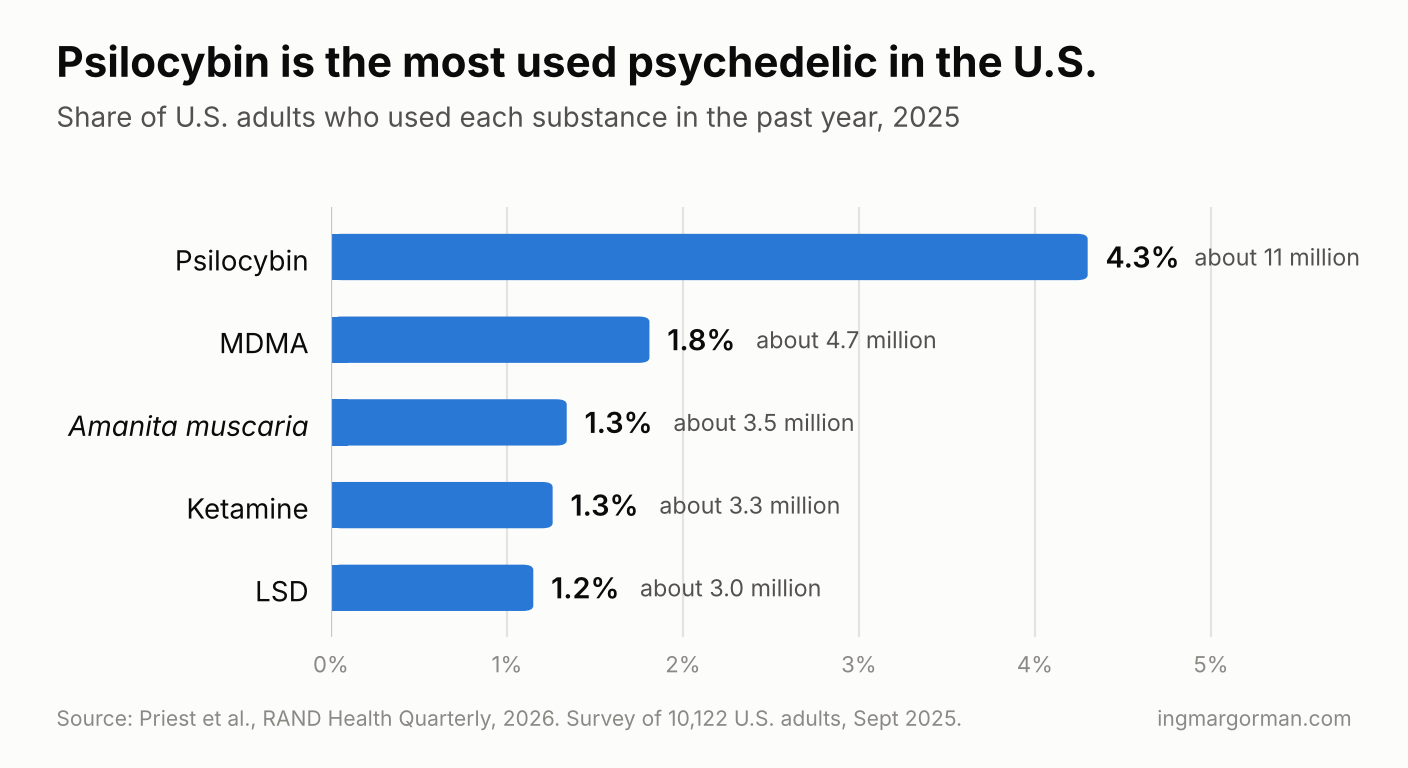
Source: RAND Health Quarterly, 2026.
How common is microdosing psilocybin?
Most people who used psilocybin in the past year microdosed at least once: 69%. The survey defined microdosing as taking a small fraction of a regular dose, low enough not to produce noticeable psychedelic effects.
Across psilocybin, MDMA and LSD combined, the authors estimate about 9.5 million U.S. adults microdosed in the past year. Microdosing also accounted for almost half of all psilocybin use days (47%). Yet because each microdose is small, the authors estimate it made up less than 10% of the total psilocybin people consumed.
In other words, many people are taking small amounts often, rather than large amounts occasionally. That pattern has its own questions, which I come back to below.
What does this study not tell us?
The survey tells us how many people microdose. It does not tell us whether microdosing helps, whether it is safe over time, or why people do it. Those are different questions, and this study wasn't designed to answer them.
A few honest limits:
Everything is self-reported. People may misremember, or define "microdose" differently. There is no way to confirm what substance or amount anyone actually took.
Some groups are small. Estimates for LSD microdosing rest on 90 respondents, so they are imprecise.
The "less than 10%" figure is an estimate. It assumes a microdose is about a tenth of a regular dose, and that people rarely take both on the same day.
No outcomes were measured. The study collected no data on mental health effects, benefits or side effects.
The broader evidence on microdosing benefits is mixed. In one of the largest placebo-controlled studies, a 2021 self-blinding citizen-science study, people who microdosed improved, but so did people taking placebo, with no significant difference between the groups. That is part of why I'm cautious about strong claims in either direction. I covered safety in more detail in Microdosing and Psychedelic Safety Principles.
Is microdosing psilocybin safe?
We don't yet know enough to call regular microdosing safe, and a small dose does not mean zero risk. The questions that worry clinicians most are about repeated use over months, not a single small dose.
Three concerns stand out:
Heart health with long-term use. In the body, psilocybin becomes psilocin, which strongly activates a serotonin receptor called 5-HT2B. This receptor is found in heart valves, and other drugs that activate it over long periods, such as the diet drug fenfluramine, have caused valve damage. A 2024 review concluded that even a small dose of psilocybin may produce enough psilocin to activate this receptor, which raises the question of whether repeated microdosing over months could carry a similar risk. No study has tested this in people who microdose, and the authors call the risk uncertain. It is an open question, not a proven harm, but it is a reason not to treat regular microdosing as trivial.
You often don't know what you're taking. Unregulated products vary in strength and content. In December 2024, the FDA told food makers that Amanita muscaria is not authorized in food, after poison centers logged hundreds of calls about it in a year. In June 2024, mushroom-branded chocolates and gummies sold as Diamond Shruumz were recalled after people became seriously ill. FDA testing of the products found substances including psilocin and the prescription drug pregabalin.
Interactions and mental health history. Psilocybin can interact with some psychiatric medications; antidepressants, for example, may change how it feels. It may also be risky for people with a personal or family history of psychosis or bipolar disorder. In a large Swedish twin study, psychedelic use was linked to more manic symptoms among young people with a higher genetic risk of bipolar disorder. Talk with a prescriber before combining anything with your medication.
Psilocybin is also still illegal under federal law and in most states, including New York, outside of approved research. A few states, such as Oregon, Colorado and New Mexico, have created regulated programs.
What should you consider if you microdose?
If you microdose, the most useful step is to look honestly at why you're doing it and whether it's working. Microdosing is often an attempt to manage something: low mood, anxiety, focus, burnout or a feeling of being stuck.
Some questions I'd encourage anyone to ask themselves:
What am I hoping this will change, and how would I know if it did?
Am I using it instead of addressing something I'd rather avoid?
Has anyone I trust, a doctor or therapist, heard about it?
These are not questions with right answers. They're the starting point for a conversation that is easier to have with someone who won't judge you. That is what psychedelic integration therapy is for: making sense of your experiences and intentions, whatever substance or dose is involved. If microdosing is part of how you're coping with low mood, anxiety or stress, therapy for those concerns can sit alongside it, giving you more ways to work with what you're going through.
For how U.S. patterns compare with other countries, see my post on the Global Psychedelic Survey.
How I work with this
I'm Ingmar Gorman, PhD, a clinical psychologist licensed in New York who offers telehealth psychotherapy and psychedelic integration therapy. I have served as a clinical trial investigator in psychedelic treatment research, co-founded Fluence, where I led psychedelic therapist training from 2019 to 2025, and co-direct EPIC, the European Platform for Integration of MDMA in Mental Health Care.
In my work, people who microdose are welcome as they are. I don't provide psychedelics or advice on sourcing or dosing. I offer a space to think clearly about what you're doing, why, and what you want from it.
Frequently asked questions
How many Americans microdose psilocybin?
A 2025 RAND survey estimated that about 11 million U.S. adults used psilocybin in the past year, and 69% of them microdosed at least once. Across psilocybin, MDMA and LSD, about 9.5 million adults microdosed in the past year.
What is microdosing?
Microdosing means taking a small fraction of a regular dose of a psychedelic, low enough that it doesn't produce noticeable psychedelic effects. Many people follow a schedule over several weeks. One of the best known is the Fadiman protocol, named after psychologist James Fadiman: one microdose day, then two days off, repeated.
Does microdosing psilocybin work?
The evidence is mixed. Many people report benefits, but in a large placebo-controlled study of psychedelic microdosing, people who microdosed and people taking placebo improved about the same. The RAND survey measured how common microdosing is, not whether it helps.
Is microdosing psilocybin legal in New York?
No. Psilocybin is illegal under federal law and in New York outside approved research. A few states, such as Oregon, Colorado and New Mexico, have created regulated psilocybin programs.
Can a therapist help if I microdose?
Yes. A therapist trained in psychedelic integration can help you look at why you microdose, whether it's helping, and any concerns about safety or habit, without judgment. A therapist should not supply psychedelics or advise on sourcing or dosing.
Talk it through
If you microdose, or you're considering it, and want a thoughtful, non-judgmental space to talk it through, I offer telehealth sessions for adults residing in New York State. Book a free 30-minute consultation.
This post is for educational purposes only. It is not medical advice and is not a substitute for individual care.
References
Priest M, Kilmer B, Senator B, Setodji CM. U.S. psychedelic use and microdosing in 2025: Insights from a probability-based and nationally representative survey. RAND Health Quarterly. 2026;13(3):2. https://doi.org/10.7249/rhq-13-03-02
Szigeti B, Kartner L, Blemings A, Rosas F, Feilding A, Nutt DJ, Carhart-Harris RL, Erritzoe D. Self-blinding citizen science to explore psychedelic microdosing. eLife. 2021;10:e62878. https://doi.org/10.7554/eLife.62878
Rouaud A, Calder AE, Hasler G. Microdosing psychedelics and the risk of cardiac fibrosis and valvulopathy: Comparison to known cardiotoxins. Journal of Psychopharmacology. 2024;38(3):217-224. https://pmc.ncbi.nlm.nih.gov/articles/PMC10944580/
Halman A, Kong G, Sarris J, Perkins D. Drug–drug interactions involving classic psychedelics: A systematic review. Journal of Psychopharmacology. 2024;38(1):3-18. https://doi.org/10.1177/02698811231211219
Simonsson O, Mosing MA, Osika W, Ullén F, Larsson H, Lu Y, Wesseldijk LW. Adolescent psychedelic use and psychotic or manic symptoms. JAMA Psychiatry. 2024. https://doi.org/10.1001/jamapsychiatry.2024.0047
U.S. Food and Drug Administration. FDA alerts industry and consumers about the use of Amanita muscaria or its constituents in food. December 18, 2024. https://www.fda.gov/food/hfp-constituent-updates/fda-alerts-industry-and-consumers-about-use-amanita-muscaria-or-its-constituents-food
Centers for Disease Control and Prevention. Severe illness potentially associated with consuming Diamond Shruumz brand chocolate bars, cones, and gummies. https://www.cdc.gov/environmental-health-studies/outbreak-investigation-diamond-shruumz-products/index.html
Fadiman J. The Psychedelic Explorer's Guide: Safe, Therapeutic, and Sacred Journeys. Park Street Press; 2011.